
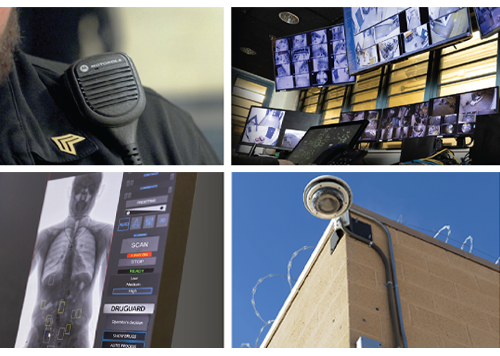
Every correctional facility in the country is fighting the same quiet war. It doesn’t happen at the front gate, where metal detectors do their job well enough. It happens against contraband that’s been swallowed, hidden internally, or tucked somewhere a pat-down will never reach. For decades, the only real answer was the strip search: invasive, slow, and still not foolproof. Today, more facilities are turning to full-body scanning technology instead, and the officers using it every day are seeing results that go well beyond a few confiscated pills.
We sat down with two corrections professionals living this shift firsthand: Lt. Rivas of the Sandoval County Detention Center, and Mark Gallegos of the Lee County Jail. Their stories, told in their own words below, make the case better than any spec sheet could.
We See That Something Is Inside the Body
Before Sandoval County Detention Center brought in a body scanner, staff relied on strip searches, a method with a built-in blind spot. “We won’t see anything on the outer part of the body,” Lt. Rivas explains, describing how inmates would smuggle drugs into the facility and pass them along once inside. A strip search catches what’s visible. It can’t catch what’s been swallowed or hidden internally, and that gap was exactly what inmates were exploiting.
The scanner closed it. Now no one enters general population until staff have a clear scan. That one procedural change, hold until cleared, has shifted the odds for anyone trying to beat the system. Sandoval County sees a high number of repeat offenders, and repeat offenders learn how a facility runs. They know the scanner will find what a strip search would have missed, and that knowledge changes behavior before an inmate ever steps into the scanner. Some hand over contraband voluntarily. Others admit it when asked directly. And when neither happens, the scan simply confirms what staff already suspect, so the contraband gets pulled before it ever reaches a housing unit.
That’s the part worth sitting with. The technology isn’t just catching contraband. It’s stopping people from trying in the first place. A scanning policy that’s visible and consistently enforced becomes its own deterrent: inmates stop trying because they know trying won’t work.
Correlation Supports Causation
If Lt. Rivas’s story is about deterrence, Lee County’s is about scale. In the very first week their body scanner was running, staff recovered more than 100 fentanyl pills and 400 strips of Suboxone, a haul that would likely have reached general population undetected without it.
But the number that stands out most isn’t the contraband count. It’s what happened to use-of-force incidents afterward. “Last month we only had one use of force inside of our facility,” Mark Gallegos says, comparing that to a facility that historically logged a much higher rate. His read on it is direct: “I think that we’re correlating that the, you know, hard to get drugs into the facility will reduce the violence inside the facility as well.”
That’s not a casual hunch. It lines up with what research on drug availability inside correctional facilities has consistently found.
Why Fewer Drugs Means Fewer Incidents
The link between contraband drugs and facility violence isn’t anecdotal. Research funded by the National Institute of Justice has found that the drug trade inside correctional facilities runs like a lucrative criminal enterprise, and inmate gangs often use violence to protect their piece of it. Once that economy takes hold inside a facility, it creates pressure that wasn’t there before: debt, coercion, and territorial disputes among inmates, plus the risk of staff being manipulated or compromised into helping move product. On top of that, inmates under the influence of drugs are more likely to turn violent toward staff or each other, which is exactly the pattern Mark Gallegos is describing.
National data backs up how closely drug use tracks with the population moving through the justice system. Bureau of Justice Statistics research found that roughly a third of state prisoners and about a quarter of federal prisoners reported being under the influence of drugs at the time of their offense. That’s not a population that stops needing, or seeking, drugs once incarcerated. If anything, demand inside a facility can be just as strong as it was outside, which is exactly why supply matters so much.
And supply itself has changed in ways that raise the stakes. Fentanyl has changed what “contraband drugs” even means in a correctional setting. Nationally, deaths involving synthetic opioids like fentanyl climbed from roughly 3,100 in 2013 to nearly 73,000 in 2023: more than a twenty-three-fold increase in a decade, and for a period, the leading cause of death among American adults under 45. A single fentanyl-laced pill making it past intake isn’t a minor infraction. It’s a potential in-custody death, a lawsuit, and a preventable tragedy rolled into one.
Other facilities are seeing the same pattern Sandoval County and Lee County describe. In California, a multi-site contraband interdiction pilot found that millimeter wave body scanners and baggage or parcel X-ray systems together accounted for 89% of all contraband discoveries, with most items entering through personal effects or hidden on the person. In Maine, Somerset County Jail added a body scanner as an extra layer beyond metal detectors and drove contraband incidents down to zero. A jail in Missouri reported a 90% drop in drug contraband after pairing a body scanner with a drug amnesty box. And in Oklahoma, jailers at the Rogers County Sheriff’s Office use their scanner the same way Lt. Rivas does: to isolate anyone flagged before contraband, especially fentanyl, ever reaches general population.
The pattern holds across very different facilities, in very different states, using slightly different equipment. Catch contraband at the door, and everything downstream from that door, violence, overdoses, use of force, starts trending in the right direction.
It’s also worth understanding why older screening methods keep falling short, even at facilities that use them diligently. Metal detectors remain the baseline in most facilities because they’re inexpensive and easy to train on, but they were never built to catch narcotics, and they can’t. Anything non-metallic walks right through. Strip searches close some of that gap, but they rely entirely on visual inspection, so anything concealed internally is, by definition, invisible to the officer doing the search. That’s the exact limitation Lt. Rivas points to when he describes what strip searches at Sandoval County could and couldn’t catch. Full-body scanning technology exists to close that remaining gap: it identifies both metallic and non-metallic contraband, including items hidden internally, without depending on an officer’s ability to see it.

Why This Matters Beyond the Statistics
It’s tempting to treat numbers like “100 fentanyl pills in one week” or “one use of force last month” as impressive data points and move on. But behind each of those numbers is an officer who didn’t have to respond to a fight, an inmate who didn’t overdose in a cell where help might not arrive in time, and a facility that didn’t have to investigate how a controlled substance ended up in general population. Corrections staff work in an environment where the margin for error is thin and the cost of a missed search is severe, for inmates and officers alike. Every pill or strip that never makes it past intake is a chain of harm that never gets to start.
This is also a staffing and morale issue, plain and simple. Facilities with chronic contraband problems tend to see more incidents that require intervention, more paperwork, more investigations into how substances got in, and more scrutiny of staff who may have been pressured or compromised. Cutting the volume of contraband reaching housing units doesn’t just protect inmates. It protects the people working those units every day, closing off one of the most common paths to coercion and corruption.
The Understaffing Problem Makes All of This Worse
None of this happens in a vacuum. Nearly every facility in the country is running with fewer officers than it needs, and that changes how much any single incident actually costs a facility, not just in dollars, but in staff hours nobody has to spare.
The scale of the shortage is real. The number of corrections officers employed by state governments fell 23% between 2012 and 2023, dropping from roughly 236,890 to 181,650 nationwide, and the workforce has kept shrinking since. By mid-2022, local jails were operating with four inmates for every correctional officer, up from three-to-one just two years earlier. Individual states show how bad this has gotten on the ground. Tennessee’s state prison vacancy rate reached 26.6% in early 2025. Virginia’s corrections vacancy rate hit 18.6% by late 2025, with some regions over 40%. North Carolina now has roughly one in four state prisons operating with half or more of their correctional officer positions unfilled. The American Correctional Association’s own 2024 survey found security officer vacancy rates as high as 55% at some agencies, with annual turnover reaching 48% in the worst cases.
When a facility is already short-staffed, every contraband-related incident competes for time and attention it doesn’t have. A single use-of-force response pulls officers away from their posts, triggers documentation and investigation requirements, and often needs additional staff to respond, secure the area, and process what happened, all on top of the daily workload a short-staffed shift is already struggling to cover. A facility that cuts its use-of-force incidents from “quite a few” per month down to one, the way Mark Gallegos describes, isn’t just improving safety outcomes. It’s giving already-stretched staff hours back that would otherwise go to incident response, paperwork, and follow-up investigation.
There’s a human cost on top of the operational one. Correctional officers already have one of the highest rates of intentional workplace injury of any profession. Research has found that 29% of officers report being seriously injured on the job, and 85% report witnessing a serious injury to a colleague. Chronic exposure to violence and critical incidents takes a real toll: one national study of correctional workers found PTSD rates around 27%, and separate research estimates that roughly 20% of officers experience what researchers call “corrections fatigue,” a pattern of negative personality change and declining health tied directly to repeated exposure to violence on the job. That toll doesn’t stay contained to one officer. It’s a documented driver of the turnover and retention crisis facilities are already fighting, which means every prevented incident is also, indirectly, a small deposit back into staff retention and facility culture.
This is the piece that’s easy to miss when you evaluate scanning technology purely as a contraband-detection tool. In an environment where every facility is already asking too few officers to do too much, anything that reduces the frequency and severity of violent incidents isn’t a nice-to-have. It’s a direct cut to the burden placed on a workforce that’s already stretched past what it was built to handle. Fewer fights to break up. Fewer injuries to treat and document. Fewer investigations into how a substance made it past intake. And for the officers who stay on the job day after day, a measurably safer place to do it.

What’s Really at Stake: Beyond the Contraband Itself
It’s easy to think of a body scanner as a tool that stops drugs. What Lt. Rivas and the Lee County team are really describing is a tool that stops everything drugs cause once they’re inside. When contraband is caught before intake, facilities are preventing:
**Direct safety outcomes**
– Overdoses and overdose deaths, including fentanyl poisoning of inmates who may not even know what they’ve been given
– Violence and assaults, both inmate-on-inmate and inmate-on-staff
– Use-of-force incidents tied to drug-fueled altercations
– Disciplinary infractions and facility lockdowns
**Facility economy and control**
– The internal black market that drives gang activity and violence
– Debt, extortion, and coercion built around drug distribution in housing units
– Staff manipulation and corruption, as outside contacts pressure compromised employees to keep supply moving
**Health and medical impact**
– Secondary exposure risks to staff and other inmates handling unknown substances
– Medical emergencies and the response costs that come with them: Narcan administration, ER transfers, follow-up care
– Relapse and interrupted recovery for inmates trying to get clean while incarcerated
**Operational and legal exposure**
– Invasive strip searches, which scanning technology significantly cuts the need for
– Liability and litigation risk tied to in-custody deaths or injuries
– Rehabilitative programming undercut by active drug use
**The deterrence effect**
– The behavior change both officers describe: repeat offenders giving up or ditching contraband before they’re even scanned, because they already know getting caught is close to certain
That last point deserves its own weight. A scanner doesn’t just catch contraband. A scanning policy that’s consistently enforced changes the math for the people trying to bring it in. Once inmates understand the scan isn’t optional and the equipment reliably works, the smartest move becomes not trying at all.

The Common Thread
Two facilities. Two different states. Two officers who’ve never compared notes, describing the same outcome from two different angles. Lt. Rivas talks about closing the blind spot strip searches always had, and about repeat offenders changing their behavior once they understand what the scanner can see. Mark Gallegos talks about the sheer volume caught in a single week, and about a use-of-force trend that dropped once the drug supply dried up. Put those two accounts together and the message is hard to miss: reduce what gets into a facility, and you reduce what happens inside it.
This isn’t a marginal improvement measured in confiscated pills. It’s a shift in the underlying safety of a facility: fewer overdoses, fewer violent incidents, fewer compromised staff, and fewer inmates whose recovery gets derailed by what’s circulating around them. If you’re weighing whether scanning technology is worth the investment, the people already running facilities with one in place are consistent and direct: it works, and it keeps working long after the first scan.
If your facility is still relying on strip searches and metal detectors alone, the gap Lt. Rivas describes, the part of the body a pat-down simply can’t see, is still open. We work with correctional facilities to design, install, and support body scanning systems built for exactly this challenge. Reach out to our team to talk through what a scanner could mean for your facility’s contraband numbers, your use-of-force trends, and the safety of everyone inside your walls.